CPA firms are under constant pressure to manage growing workloads, meet client expectations, maintain accuracy, and control operating costs. At the same time, finding and retaining qualified accounting professionals can be challenging, particularly during tax season and other periods of increased demand.
Offshore staffing for CPA firms has emerged as a practical way to address these challenges. By building an offshore team of qualified accounting professionals, CPA firms can access skilled talent, manage workloads more efficiently, and create additional capacity without significantly increasing their overhead.
But offshore staffing is about more than reducing labor costs. When implemented strategically, it can help CPA firms improve productivity, expand service capacity, and focus their in-house professionals on higher-value activities.
What Is Offshore Staffing for CPA Firms?
Offshore staffing involves working with accounting professionals located in another country to support a firm's accounting, tax, bookkeeping, audit, and administrative functions.
An offshore team can work as an extension of a CPA firm's existing workforce. Depending on the firm's requirements, offshore professionals may handle recurring tasks such as bookkeeping and accounts payable or provide specialized support for tax preparation, financial reporting, and audit processes.
The CPA firm's in-house team remains responsible for client relationships, review, strategic decisions, and final oversight, while the offshore team provides additional operational capacity.
How Offshore Staffing Helps CPA Firms Reduce Costs
1. Lower Staffing and Operational Costs
One of the primary reasons CPA firms explore offshore staffing is the potential to reduce employment and operational expenses.
Hiring locally involves more than salary. Firms may also need to account for benefits, office space, equipment, recruitment expenses, training, payroll taxes, and other employee-related costs.
Offshore staffing can provide access to qualified professionals at a different overall cost structure. This can allow firms to increase their workforce without carrying the same level of overhead associated with expanding an entirely local team.
The savings can be particularly valuable for small and midsized CPA firms looking to grow while maintaining healthy margins.
2. Reduce Recruitment and Hiring Pressure
Recruiting accounting professionals can take significant time and resources. A position may remain open for weeks or months, especially when firms are looking for professionals with specific technical skills.
Offshore staffing gives CPA firms access to a broader talent pool. Instead of limiting recruitment to professionals within a particular local market, firms can work with qualified accounting talent internationally.
This can make it easier to build teams based on skills and workload requirements rather than geographic availability alone.
3. Handle Seasonal Workloads More Efficiently
Tax season can create significant pressure for CPA firms. Workloads can increase rapidly, while deadlines remain fixed.
Hiring permanent employees solely to accommodate seasonal demand may not always be practical. Offshore staffing provides another option: firms can increase their available capacity when workloads rise without necessarily expanding their permanent local workforce to the same extent.
An offshore team can assist with tasks such as tax preparation support, bookkeeping, reconciliations, document preparation, and other standardized processes.
This additional capacity can help internal teams manage peak periods more effectively.
How Offshore Staffing Helps CPA Firms Scale Faster
4. Increase Service Capacity
Growth becomes difficult when a firm's existing employees are already operating at full capacity.
Offshore staffing allows CPA firms to add resources as their client base grows. Instead of turning away work because there are not enough employees to handle it, firms can use offshore professionals to support additional engagements.
This creates greater capacity without requiring every new client to result in a proportional increase in local staffing and infrastructure.
5. Free In-House Professionals for Higher-Value Work
Not every accounting task requires direct involvement from senior CPA professionals.
Routine and time-consuming activities can consume valuable hours that could otherwise be spent on client advisory, financial analysis, business development, and relationship management.
With the right workflow, offshore professionals can handle appropriate back-office and accounting support tasks while senior team members focus on activities that require their expertise.
This division of responsibilities can improve overall productivity and allow CPA firms to make better use of their most experienced employees.
6. Support Faster Turnaround Times
An offshore team can provide additional capacity for processing work, especially when responsibilities are clearly defined and workflows are standardized.
For firms operating across different time zones, offshore staffing can also support extended work cycles. Work completed by an offshore team can be reviewed by the local team during its regular working hours.
This model can help firms organize work more efficiently and potentially improve turnaround times without requiring local employees to work extended hours.
What Tasks Can CPA Firms Offshore?
The tasks suitable for offshore staffing depend on the firm's processes, technology, security requirements, and client needs. Common areas include:
- Bookkeeping and general ledger maintenance
- Accounts payable and accounts receivable
- Bank and credit card reconciliations
- Tax preparation support
- Payroll processing support
- Financial statement preparation
- Audit support and documentation
- Data entry and accounting administration
- Accounts cleanup and catch-up bookkeeping
- Research and reporting support
The key is to establish clear responsibilities and review procedures before transferring work to an offshore team.
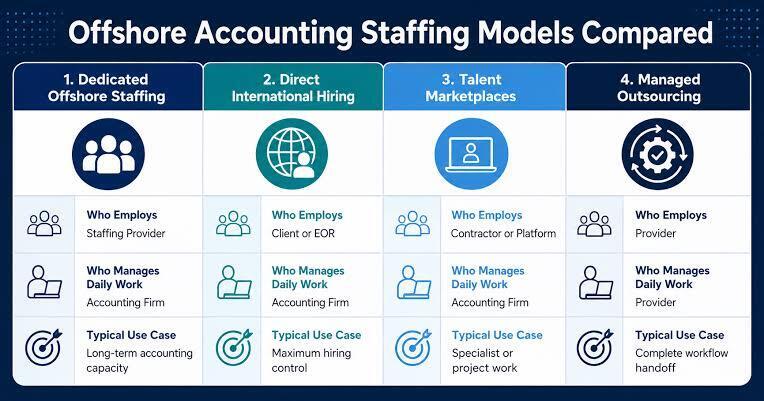
Choosing the Right Offshore Staffing Model
Successful offshore staffing requires more than simply hiring low-cost workers. CPA firms should consider qualifications, accounting experience, communication skills, technology capabilities, data security, and familiarity with relevant accounting software.
A well-defined onboarding process is equally important. Offshore professionals should understand the firm's workflows, documentation standards, deadlines, quality expectations, and communication procedures.
Firms should also establish review and quality-control processes. Sensitive financial information requires appropriate access controls, secure systems, confidentiality measures, and clearly defined responsibilities.
Making Offshore Staffing a Long-Term Growth Strategy
The greatest value of offshore staffing comes when it becomes part of a firm's broader operational strategy rather than being treated as a short-term cost-cutting measure.
CPA firms can begin with specific, repeatable processes and gradually expand the offshore team's responsibilities as trust and operational maturity develop.
Regular performance reviews, clear communication, standardized procedures, and appropriate technology can help create a productive relationship between the local and offshore teams.
Conclusion
Offshore staffing for CPA firms can provide a flexible way to address talent shortages, manage seasonal workloads, reduce operating expenses, and increase service capacity. By delegating appropriate accounting and administrative tasks to a skilled offshore team, CPA firms can allow their in-house professionals to focus on client relationships, advisory services, and strategic growth.
However, successful offshore staffing depends on selecting qualified professionals, establishing strong workflows, maintaining appropriate security controls, and creating effective communication and quality-review processes.
For CPA firms looking to grow without allowing staffing constraints and rising overhead to limit their capacity, offshore staffing can be an important component of a scalable operating model.


 Search in Classifieds
 Search in Groups
 Search in Polls
 Search in Members
 Search in Members
 Search in News
 Search in Businesses
 Search in Contests
 Search in Events
 Search in Music Albums
 Search in Music Songs
 Search in Quotes
 Search in Site Team



Share this page with your family and friends.