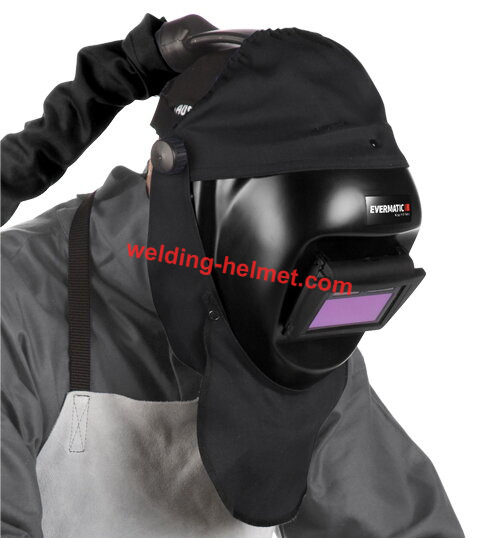
Lens technology has become an important part of modern welding protection because the viewing system must respond to intense arc light while maintaining a usable view of the work area. An automatic welding mask combines optical filtering, electronic control, and protective layers inside a compact lens assembly, while welding-helmet develops related welding protection products around practical requirements from fabrication and metalworking environments. The basic idea is simple, but how does the lens react when the welding arc suddenly appears?
At the center of an auto-darkening lens is the ADF, or auto-darkening filter. Unlike a traditional fixed shade lens, an ADF can change its optical state when the system detects the characteristic light produced by an arc. The filter normally allows the user to see the workpiece during preparation, positioning, and inspection. When welding begins, sensors detect the arc and send a signal to the electronic control system, which changes the liquid crystal layer into a darker state.
Liquid crystal technology is particularly important because the lens does not rely on a permanently dark viewing filter. Instead, the optical condition can be controlled electronically. The liquid crystal layer works together with polarizing components and fixed protective filters. This layered construction allows the lens to provide a clear viewing condition before welding while maintaining protection against ultraviolet and infrared radiation. Such UV and IR protection remains important even when the visible shade is in its light state.
The response system also depends on arc sensors. Sensors detect changes in the surrounding light and activate the darkening mechanism when an appropriate welding arc is identified. Different lens assemblies can use different sensor arrangements. Some models use two sensors, while other configurations include four sensors to support arc detection from various positions. This can be useful when welders work with changing angles, restricted spaces, or different welding positions.
Optical quality is another important part of lens design. A filter is not useful only because it becomes dark. The viewing image also needs to remain sufficiently clear and consistent so that the operator can observe the joint, electrode, torch, and surrounding workpiece. Optical classifications such as 1/1/1/2 are used to describe several aspects of optical performance, including clarity, diffusion, uniformity, and angular dependence. Several RLINGD lens products listed by the manufacturer use this optical classification.
Color perception has also become an area of interest in welding lens development. Conventional dark filters can alter the appearance of the working area, which may make certain details less intuitive to observe. True-color technology is designed to produce a more natural visual impression while the lens remains in its protective state. For welding operators who need to observe subtle changes around a weld, color representation can form part of the overall viewing experience. Certain RLINGD filter configurations include a true-color option.
Shade adjustment provides another layer of flexibility. Different welding processes generate different arc conditions, so a single fixed visual setting may not suit every task. Adjustable dark shades allow users to select an appropriate filter condition according to the welding process and working environment. Product configurations available from welding-helmet include variable shade options, sensitivity adjustment, delay control, grinding functions, and cutting functions on selected models.
Sensitivity control is closely connected with this function. A welding area may contain reflections, nearby arcs, workshop lighting, or other sources of brightness. If the sensor system is excessively sensitive, unnecessary activation can interfere with the working rhythm. If sensitivity is insufficient, arc detection may not respond as expected. An adjustable control gives the operator a way to adapt the filter to the surrounding conditions instead of treating every workshop as identical.
Delay adjustment serves a different purpose. When welding stops, the lens does not necessarily need to return to its light state immediately. A controlled delay can keep the darker condition for a short period after the arc disappears, which can be useful when the operator is working through repeated starts and stops. The exact setting depends on the welding process, ambient conditions, and individual working habits.
Power management is another consideration because electronic auto-darkening depends on an energy source. Some filter systems combine lithium batteries with solar assistance, while selected designs use replaceable batteries. Solar charging can support regular operation under suitable lighting conditions, whereas a replaceable battery design gives users a straightforward maintenance option. The appropriate arrangement depends on the intended application, working schedule, and helmet configuration.
The physical structure around the filter also affects the overall lens system. The viewing panel needs to sit securely inside the helmet while remaining protected from sparks, dust, impact, and workshop conditions. The external shell and filter housing therefore work together rather than functioning as completely separate components. A lens with suitable electronic performance still requires a compatible mechanical structure to provide a practical welding protection system.
Viewing area is another factor that deserves attention. A compact viewing window can suit certain lightweight designs, while a larger active viewing area may provide a wider perspective during positioning and inspection. The appropriate size depends on the helmet structure, working position, application, and operator preference. Product families can therefore include different filter dimensions and viewing-area configurations instead of relying on one universal design.
Different welding processes also place different demands on the lens. TIG welding can involve a relatively concentrated arc and detailed joint observation, while MIG and arc welding may involve different light characteristics and working movements. Grinding and cutting introduce another set of requirements. For this reason, a lens system with adjustable shade, sensitivity, delay, or function selection can provide useful flexibility across several workshop activities.
For buyers evaluating welding protection equipment, lens technology should therefore be considered as a complete system rather than as a single darkening feature. Sensor arrangement, liquid crystal behavior, UV and IR filtering, optical classification, shade adjustment, viewing area, power supply, and physical protection all influence how the product fits a particular working environment. The selection process can begin with the welding method and working conditions, followed by a review of the lens specifications and helmet structure.
For manufacturers, distributors, and welding equipment buyers researching different configurations, the product range and technical information available through welding-helmet can provide a useful starting point for comparing lens structures, filter functions, and application requirements. The related product information can be reviewed through the official product section at https://www.welding-helmet.com/product while buyers consider how an Automatic Welding Mask should match optical performance, sensor behavior, power design, and the welding environment in which the equipment will be used.


 Search in Classifieds
 Search in Groups
 Search in Polls
 Search in Members
 Search in Members
 Search in News
 Search in Businesses
 Search in Contests
 Search in Events
 Search in Music Albums
 Search in Music Songs
 Search in Quotes
 Search in Site Team




Share this page with your family and friends.