Real estate tokenization is changing how property ownership and investment can be represented in digital markets. Instead of keeping property ownership records only through conventional documents and institutional systems, tokenization represents rights linked to a property through blockchain-based tokens. This approach can support fractional ownership, digital transfers, automated distributions, and structured investor participation.
However, creating property tokens is only one part of the process. A successful real estate tokenization platform development project needs a well-planned lifecycle that explains what happens before a token is issued, how it reaches investors, how ownership changes are recorded, how income is distributed, and what happens when the asset reaches maturity or is sold.
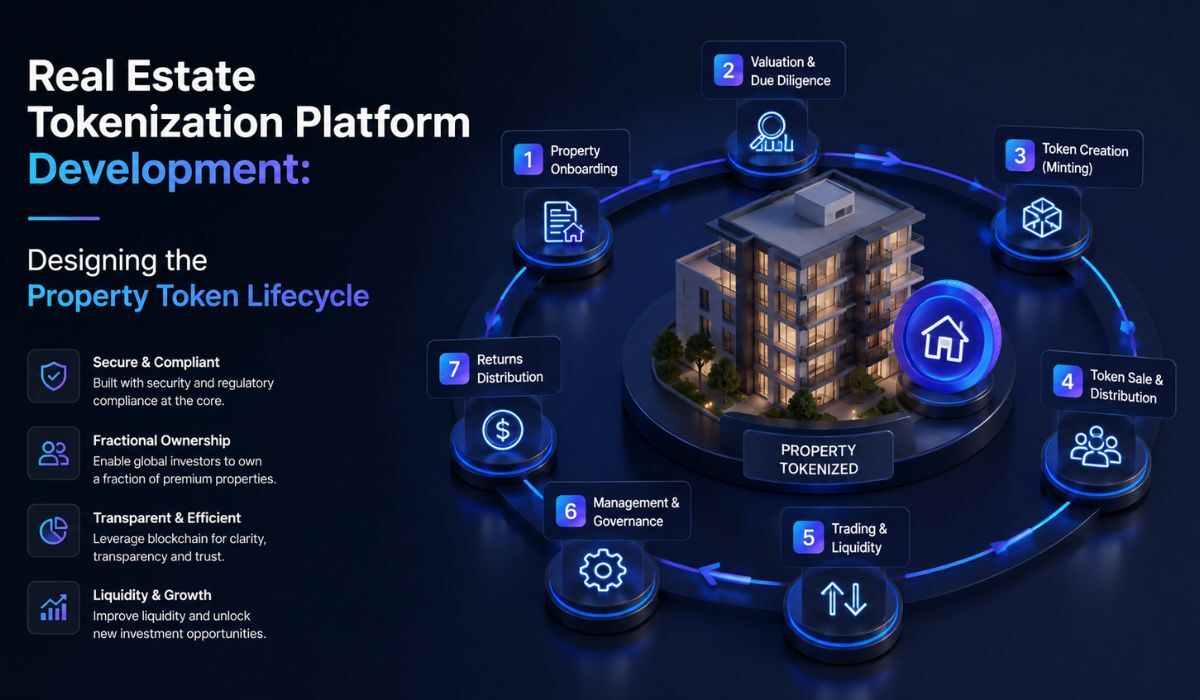
The property token lifecycle therefore acts as a framework connecting real estate assets, legal structures, investors, blockchain networks, compliance processes, and marketplace functions. A real estate tokenization company needs to consider every stage while designing the platform so that the token remains useful and properly managed throughout its existence.
1. Property Selection and Asset Assessment
The lifecycle starts with selecting a suitable real estate asset. The property may be residential, commercial, industrial, hospitality, healthcare, student housing, or another type of income-generating property. The platform operator needs information about ownership, valuation, location, existing liabilities, rental income, operating expenses, and expected returns.
At this stage, a real estate asset tokenization company can conduct property due diligence before moving toward token creation. Legal documents, valuation reports, ownership records, tax information, lease agreements, and financial statements can be collected and reviewed.
The platform can maintain a digital asset profile containing these records. This profile becomes an important reference for investors and administrators during later lifecycle stages.
2. Legal Structuring of the Property
A property cannot simply be converted into blockchain tokens without considering its legal structure. The property may be held directly or through a special purpose vehicle, partnership, trust, fund, or another legal arrangement depending on the jurisdiction and investment model.
The rights represented by the token must also be defined. A token may represent equity ownership, economic rights, debt exposure, revenue participation, or another contractual interest.
During real estate tokenization development, the legal model should be connected with the technical design. Investor rights, transfer restrictions, voting arrangements, distribution rules, and redemption conditions need to correspond with the token's functions.
A real estate tokenization development company may work with legal and compliance specialists to map these requirements before writing smart contracts.
3. Property Valuation and Token Economics
After legal structuring, the property is valued, and the token economics are determined. Suppose a commercial property is valued at $10 million and the issuer decides to represent the investment through one million tokens. Each token could initially represent a $10 economic interest, subject to the legal structure and offering terms.
The platform can define the total supply, initial price, minimum investment amount, distribution mechanism, investor categories, and other financial parameters.
Token economics should also consider future income. Rental revenue, property appreciation, operating expenses, taxes, management costs, and other factors can influence the investment model.
This stage connects the physical property with the digital asset. The result is a token model that reflects the financial and legal arrangement associated with the property.
4. Token Creation and Smart Contract Setup
Once the asset and legal model are ready, the digital token can be created on a suitable blockchain network. The smart contract contains the rules governing token issuance, ownership records, transfers, distributions, and other permitted actions.
The technical architecture may include investor wallets, identity verification, compliance modules, an administrative dashboard, property records, payment services, and blockchain infrastructure.
Real estate token development also requires decisions about whether tokens will be issued on a public blockchain, private network, or permissioned environment. The choice depends on regulatory requirements, transaction costs, investor access, operational preferences, and the intended market.
Smart contracts should be reviewed before deployment because an error in token logic can affect ownership records or financial operations.
5. Investor Onboarding and Compliance
After token creation, investors need a process for joining the platform. Registration can involve identity verification, investor accreditation where applicable, sanctions screening, source-of-funds checks, and other compliance procedures.
The platform can assign permissions according to the investor's verified status. For example, certain investors may be permitted to purchase specific property tokens while others may have restricted access.
This stage is particularly important because property tokens can represent regulated financial interests in some jurisdictions. A real estate tokenization platform development company therefore needs to consider the regulatory framework of each target market.
The investor dashboard can display wallet information, token holdings, property details, transaction history, distribution records, and relevant documents.
6. Primary Token Offering
Once investors are approved, the property token can enter its primary offering phase. Investors purchase tokens according to the terms defined by the issuer.
The platform can support different offering structures. A property may be divided into a fixed number of tokens, offered through a scheduled sale, or released in stages. Payment can be processed through supported fiat or digital payment methods depending on the platform's jurisdiction and regulatory model.
When a purchase is completed, the relevant number of tokens is transferred to the investor's approved wallet. The transaction is recorded on the blockchain, while supporting records can remain within the platform's database.
At this point, the token moves from issuance into active ownership.
7. Token Ownership and Portfolio Management
Once investors hold property tokens, the platform needs to maintain an accurate ownership environment. Investors should be able to view their holdings and understand what those holdings represent.
The platform can provide property-level information such as occupancy, rental income, expenses, valuation updates, distributions, and relevant announcements.
Portfolio functions can allow users to hold tokens from multiple properties. Instead of viewing each investment independently, investors can manage their property token holdings through a single dashboard.
For platform operators, administrative tools can support investor records, token supply monitoring, property reporting, transaction management, and compliance reviews.
8. Income Distribution Through the Token Lifecycle
Many tokenized real estate models generate income through rent or other property-related revenue. The platform can connect property income with investor distributions according to the legal agreement.
For example, rental income may be collected by the property management entity and allocated after deducting approved expenses. The remaining distributable amount can then be calculated according to each investor's token holdings.
Smart contracts can assist with calculating distribution amounts, while payment infrastructure handles the actual settlement. Investors can view distribution history from their dashboards.
The platform should also account for situations such as vacancies, maintenance expenses, property taxes, debt payments, and other costs that affect distributable income.
9. Secondary Market Transfers
A property token lifecycle does not necessarily end after the primary offering. Investors may want to sell their tokens before the property itself is sold.
A secondary marketplace can provide a venue for eligible investors to list and purchase tokens. However, token transfers may need restrictions based on jurisdiction, investor status, holding periods, or the legal structure of the offering.
The smart contract can check whether the receiving wallet is authorized before allowing a transfer. This creates a connection between blockchain transactions and compliance rules.
For a real estate tokenization company, the secondary market can also become an important platform feature because it gives investors another potential route for managing their holdings.
10. Property Valuation Updates
Real estate assets change in value over time. Market conditions, rental performance, development activity, interest rates, occupancy, and local demand can influence property valuation.
The platform can periodically update property valuation information using reports from approved valuation professionals or data providers. These updates can appear on the asset dashboard and may influence secondary-market pricing.
Valuation updates should not automatically imply that the token price will move by the same amount. Market demand, liquidity, investor sentiment, and transaction conditions can also influence token pricing.
Maintaining updated asset information helps investors understand the current status of the underlying property.
11. Corporate Actions and Investor Voting
Some property structures require investors to participate in decisions. Examples may include refinancing, major renovations, property sales, changes to management arrangements, or other actions defined in the investment agreement.
The platform can provide digital voting functions where permitted. Token holdings can determine voting rights according to the governing documents.
The voting process may involve proposals, investor eligibility checks, voting periods, result calculation, and recordkeeping.
This gives the token lifecycle an administrative dimension beyond buying and selling.
12. Redemption, Property Sale, and Token Retirement
The final stage arrives when the investment reaches its defined maturity or the underlying property is sold.
Suppose a tokenized property is sold after several years. The sale proceeds can be allocated according to the legal structure after applicable costs and obligations are settled. Eligible investors then receive their corresponding share.
After settlement, the platform can retire or burn the outstanding property tokens where the structure requires it. The asset record can be updated to show that the investment has reached its final stage.
This closes the lifecycle from property selection to token retirement.
Technology Components Behind the Lifecycle
A complete real estate tokenization platform development project usually involves several interconnected technical components. Blockchain infrastructure records token ownership and transactions. Smart contracts manage token rules. Wallet infrastructure handles investor holdings. Identity and compliance systems manage investor eligibility.
The platform may also include payment gateways, property management integrations, valuation data feeds, document management, analytics dashboards, notification systems, and administrative controls.
API connections can link the tokenization platform with external financial and property systems. Security controls should cover wallet management, access permissions, smart contract operations, user accounts, and sensitive records.
A real estate tokenization development company therefore needs to consider the entire operating environment rather than focusing only on token issuance.
Choosing a Development Partner
Choosing a development partner requires more than comparing development prices. Businesses should assess experience in blockchain applications, smart contracts, property-related systems, compliance workflows, investor dashboards, token standards, and marketplace functions.
A real estate tokenization development company should understand how property ownership structures connect with blockchain-based assets. Businesses researching Top real estate tokenization companies and Best real estate tokenization companies should also examine their previous project experience, supported blockchain networks, technical capabilities, security practices, and post-launch support.
The right partner can help convert the property lifecycle into a practical technical architecture while keeping the legal and financial model in view.
Conclusion
Real estate tokenization depends on more than issuing digital tokens for a property. The lifecycle begins with property assessment and legal structuring, continues through token creation, investor onboarding, primary sales, ownership management, income distributions, secondary transfers, valuation updates, and governance, and concludes with redemption or token retirement. Each stage needs to connect the property, legal agreement, investor rights, smart contracts, payment systems, and platform records. Businesses planning real estate tokenization can use this lifecycle approach to define their product requirements before development begins. Blockchain App Factory provides Real estate tokenization development services, helping businesses plan and develop platforms that support property token issuance, investor management, compliance workflows, digital ownership, marketplace functions, and lifecycle management.
FAQs
1. What is a property token lifecycle?
A property token lifecycle describes the stages a token goes through from property selection and legal structuring to token issuance, investor ownership, transfers, income distributions, and eventual redemption or retirement.
2. Why is the lifecycle important in real estate tokenization?
It provides a structured view of how the token should operate throughout the investment period. It also helps connect legal agreements, investor rights, blockchain records, payment processes, and platform functions.
3. What does real estate token development involve?
Real estate token development can involve token design, smart contract development, wallet integration, investor onboarding, compliance features, payment processing, property data management, marketplace functions, and administrative tools.
4. Can investors trade property tokens after the initial sale?
They may be able to trade them through a secondary marketplace if the legal structure and applicable regulations permit secondary transfers. Eligibility checks and transfer restrictions may apply.
5. How are rental returns distributed through a tokenization platform?
The platform can calculate distributions according to investor holdings and the governing investment agreement. Rental income is generally processed after applicable expenses and obligations are paid, before eligible investors receive their share.
6. What blockchain can be used for real estate tokenization?
The choice depends on factors such as transaction requirements, token standards, regulatory considerations, fees, ecosystem support, and the intended investor base. Ethereum-compatible networks and permissioned blockchain environments are among the options businesses may evaluate.
7. What does a real estate tokenization company provide?
Depending on its offering, a real estate tokenization company may provide platform development, smart contracts, token issuance systems, investor dashboards, compliance functions, marketplace modules, wallet integration, and ongoing technical support.
8. How long does real estate tokenization platform development take?
The timeframe varies according to the platform's features, blockchain choice, compliance requirements, integrations, marketplace functions, and testing requirements. A basic MVP generally requires less time than a full platform with secondary trading and complex property management functions.
9. What should businesses look for in a real estate asset tokenization company?
Businesses should evaluate blockchain expertise, smart contract experience, security practices, property-related project experience, compliance knowledge, integration capabilities, development methodology, and post-launch support.
10. What is the difference between real estate tokenization and real estate token development?
Real estate tokenization refers to the broader process of representing property-related ownership or economic rights through blockchain tokens. Real estate token development focuses more specifically on creating the token, smart contracts, and related technical components used in that process.


 Search in Classifieds
 Search in Groups
 Search in Polls
 Search in Members
 Search in Members
 Search in News
 Search in Businesses
 Search in Contests
 Search in Events
 Search in Music Albums
 Search in Music Songs
 Search in Quotes
 Search in Site Team



 Experience: What Guests Can Expect)


Share this page with your family and friends.