Businesses today need faster, more reliable, and more personalized ways to communicate with customers, employees, partners, and other stakeholders. As digital communication becomes a central part of everyday operations, companies are looking for solutions that can grow with their needs without requiring them to build complex technology from scratch. This is where a White Label Enterprise Messaging Platform can offer a practical advantage, allowing businesses to deliver professional messaging services under their own brand while reducing development time, costs, and technical challenges.
What Is a White Label Enterprise Messaging Platform?
A white label enterprise messaging platform is a communication solution developed by a third-party technology provider that businesses can customize and offer under their own brand name. Instead of developing a messaging infrastructure independently, companies can use an existing platform and personalize its branding, interface, features, and customer experience.
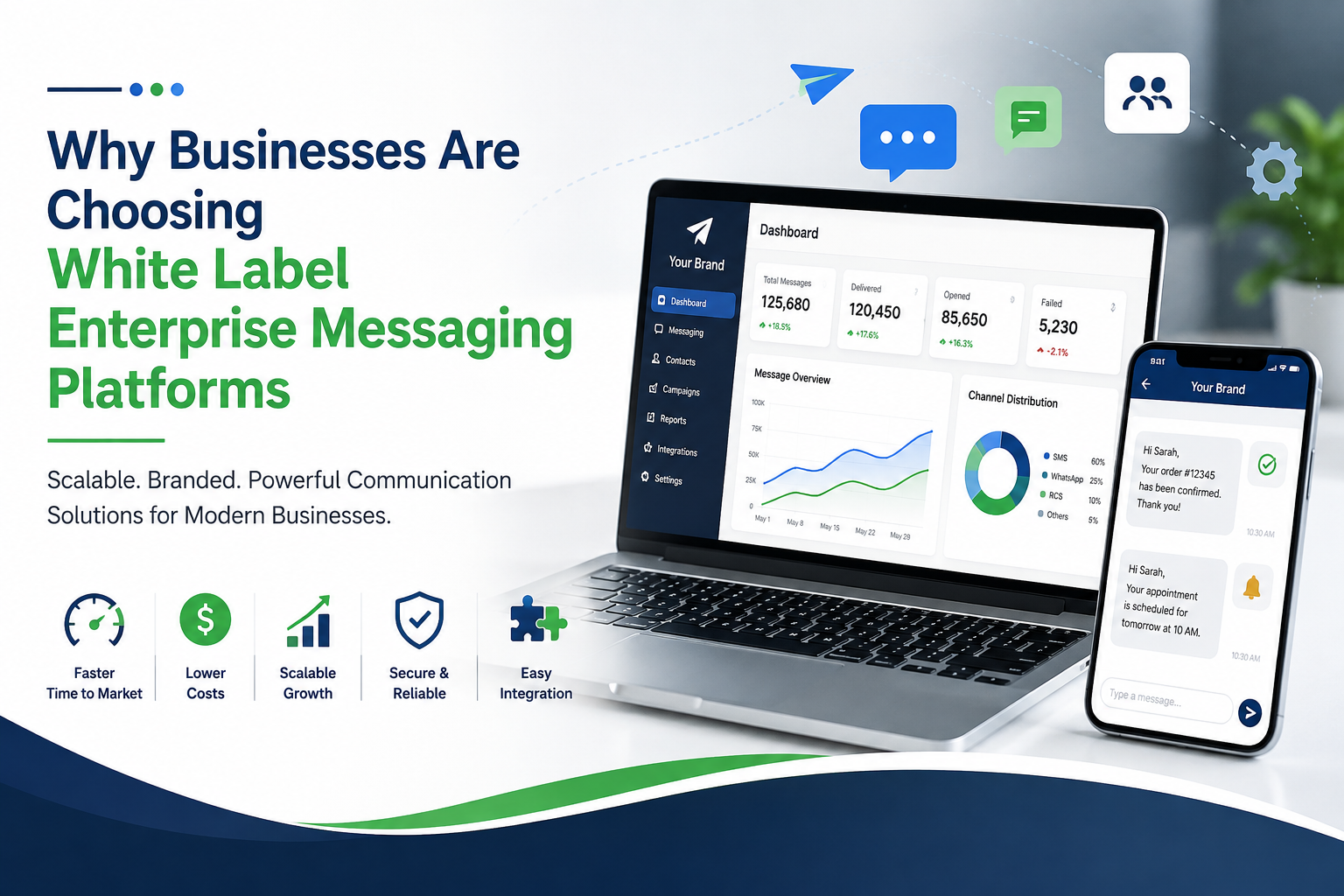
These platforms can support multiple communication channels, including SMS, business messaging, notifications, and other digital communication services. Depending on the provider, businesses may also receive features such as APIs, analytics, automation tools, user management, reporting dashboards, and integration capabilities.
For companies that want to expand their communication services quickly, this approach can be significantly more efficient than building an entire messaging ecosystem internally.
1. Faster Time to Market
One of the biggest reasons businesses are choosing white label solutions is speed. Developing an enterprise messaging platform from the ground up can require significant time, technical expertise, testing, maintenance, and financial investment.
A white label solution provides an existing technological foundation. Businesses can customize the platform according to their requirements and introduce it to their customers much faster.
This is particularly useful for companies operating in competitive industries where launching a new service quickly can create an important advantage. Instead of spending months or years developing infrastructure, businesses can focus on branding, customer acquisition, sales, and service quality.
2. Lower Development and Operational Costs
Building a proprietary messaging platform involves more than initial development expenses. Companies also need to consider server infrastructure, security, software updates, technical support, integrations, monitoring, and ongoing maintenance.
White label platforms can reduce many of these expenses because the underlying technology is already developed and maintained by a specialized provider.
This allows businesses to allocate resources toward areas that directly support growth, such as marketing, customer support, product development, and sales. For startups and growing companies, controlling technology costs without compromising service quality can be especially valuable.
3. Stronger Brand Identity
Customers generally prefer dealing with businesses that provide a consistent and professional experience. White label messaging platforms allow companies to present communication services using their own brand identity.
Businesses can often customize elements such as logos, colors, dashboards, interfaces, and other customer-facing features. As a result, users interact with a platform that feels like part of the company's own technology ecosystem rather than a third-party service.
This branding opportunity can strengthen customer recognition and help businesses build greater trust over time.
4. Scalability for Growing Businesses
A messaging solution that works for a small customer base may not always be suitable when communication volumes increase. Businesses need platforms capable of supporting growth without creating unnecessary technical complications.
Enterprise-focused white label platforms are designed to accommodate changing business requirements. Companies can expand their messaging operations, add users, manage larger communication volumes, and introduce additional services as their needs develop.
This scalability makes white label technology useful for businesses that are planning long-term expansion and do not want to repeatedly replace their communication infrastructure.
5. Access to Advanced Messaging Features
Modern businesses expect more than basic text messaging. They often require automation, analytics, scheduling, APIs, customer management, reporting, and integration with existing software.
A well-designed white label enterprise messaging solution can provide access to many of these capabilities through a centralized platform.
For example, businesses may use automation to send customer notifications, appointment reminders, promotional messages, alerts, or transactional communications. Analytics can then help teams understand delivery performance, engagement, and communication trends.
Having these tools available within one platform can make communication management more organized and efficient.
6. Easier Integration With Existing Systems
Businesses rarely operate using a single software system. They may already use customer relationship management platforms, e-commerce systems, help desks, payment solutions, marketing tools, or internal applications.
API support is therefore an important consideration when selecting a messaging platform. A flexible white label solution can integrate messaging functionality into existing business applications, allowing companies to automate communication workflows instead of managing every message manually.
For example, an online business could automatically send an order confirmation after a purchase, while a service company could send appointment reminders before scheduled visits.
These integrations can save time while creating a smoother customer experience.
7. Improved Customer Communication
Customer expectations have changed significantly. People want timely information and convenient communication from the companies they interact with.
Messaging provides businesses with a direct communication channel that can be used for important updates, notifications, promotions, support, and service-related information.
A branded messaging platform gives businesses greater control over how these communications are delivered. When combined with automation and customer data, messaging can become a valuable part of a broader customer engagement strategy.
Better communication can also reduce delays, improve customer satisfaction, and help businesses maintain stronger relationships with their audiences.
8. Greater Focus on Business Growth
Technology development can consume considerable internal resources. Companies that build everything themselves may need dedicated developers, infrastructure specialists, security teams, and support staff.
With a white label solution, much of the underlying technology is handled by the platform provider. This allows internal teams to concentrate on business priorities instead of spending all their time maintaining messaging infrastructure.
The result can be a more focused approach to growth, where the company uses technology as a business tool rather than treating technology development as the primary objective.
9. Competitive Advantage
Offering branded messaging services can also help businesses differentiate themselves from competitors. Agencies, communication providers, SaaS companies, and other technology-focused businesses can incorporate messaging capabilities into their own product portfolios.
Instead of simply reselling another company's service under a generic name, businesses can create a more integrated experience around their own brand.
This can open opportunities for additional services, recurring revenue, stronger customer retention, and deeper relationships with clients.
What Should Businesses Look For?
While white label messaging platforms offer many advantages, businesses should carefully evaluate providers before making a decision. Important factors include platform reliability, security, scalability, API capabilities, customization options, analytics, customer support, integration flexibility, and pricing.
It is also important to understand the provider's infrastructure, service coverage, compliance approach, and ability to support future business requirements. Choosing a platform based only on price can create problems later if the technology cannot scale or lacks essential features.
The Future of Business Messaging
As businesses continue moving toward digital-first communication, messaging will remain an important part of customer engagement and operational workflows. Companies need solutions that are flexible, scalable, and capable of adapting to changing communication expectations.
White label enterprise messaging platforms provide a way to access sophisticated messaging technology while maintaining control over branding and customer experience. They can reduce development requirements, accelerate market entry, support business growth, and provide access to advanced communication tools.
For companies looking to expand their digital services without building an entire messaging infrastructure from scratch, a white label approach can be a smart and efficient strategy. As communication becomes increasingly important to business success, organizations that invest in flexible messaging technology can position themselves for stronger customer relationships and sustainable growth.


 Search in Classifieds
 Search in Groups
 Search in Polls
 Search in Members
 Search in Members
 Search in News
 Search in Businesses
 Search in Contests
 Search in Events
 Search in Music Albums
 Search in Music Songs
 Search in Quotes
 Search in Site Team



Share this page with your family and friends.