In a small town called Islampur, tucked inside the Swat Valley, winter does not slow life down. It speeds it up. The town has barely 25,000 people, yet it is one of the busiest wool weaving centres in Khyber Pakhtunkhwa. Families here have woven shawls by hand for generations, on traditional underground looms called khadi.
Naik Mohammad is one of them. He is 45 years old and has spent most of his life at the loom, just like his father and grandfather before him. He has said that growing up, he would watch his parents work the khadi to make shawls, and that the craft feels less like a job and more like an identity passed down through his family. On a good day, he weaves about three shawls, each one earning him close to $1.70. Local industry leaders in the town say it takes nearly 37 people, from the shepherd who herds the sheep to the artisan who finishes the design, to turn raw wool into a single finished shawl.
That is the part most of us never think about while standing in a shop, running our fingers over a stack of shawls, trying to decide between wool, pashmina, and velvet. Every shawl carries hours of human effort long before it reaches a rack. Once you understand what actually goes into each fabric, choosing between them gets a lot easier.
After hours of research into Pakistan’s shawl industry, fabric science, and the history behind these three materials, a clear picture started to form. Here is what every Pakistani woman should know before buying her next winter shawl.
Why One Shawl Type Never Fits All
Pakistan’s winters are not the same everywhere. Karachi might need nothing more than a light wrap for a breezy evening. Lahore and Islamabad call for something warmer once the December fog rolls in. Up in Murree, Swat, or Gilgit Baltistan, the cold is sharp enough that a thin shawl will not do much good at all.
This is exactly why wool, pashmina, and velvet shawls exist side by side in the market instead of one replacing the other. Wool is built for warmth and daily wear, pashmina for softness and luxury, and velvet for occasions where you want to be noticed. Knowing which problem you are trying to solve makes the decision much simpler.
Wool Shawls: The Everyday Workhorse
Wool is the fabric most Pakistani households already trust, and for good reason. It is durable, affordable compared to pashmina, and genuinely warm in everyday winter weather.
A study titled Wool Sector Analysis for Pakistan, by researchers Akram, Butt, and Shabbir, published in the Advances in Social Sciences Research Journal, found that regions such as Khyber Pakhtunkhwa and Azad Kashmir produce some of the finer wool used for shawls and handicrafts. Sheep breeds like Lohi, Kaghani, Bibrik, and Damani are raised across different provinces, each producing wool with slightly different texture and thickness.
Regular sheep wool fibers usually measure between 25 and 40 microns in width. That thickness gives wool its strength, but it is also why wool can feel a little rougher against the skin compared to finer fibers. It is a fair trade-off, since you end up with a shawl that holds its shape, survives years of folding and travel, and still keeps you warm through a long winter.
This is also where small towns like Islampur fit into the bigger picture. Their handwoven wool shawls sell across Pakistan and are exported in smaller quantities to Afghanistan and parts of Central Asia, even though Pakistan’s overall wool exports remain modest. One industry outlook report ranked Pakistan 52nd in the world for wool exports in 2021, a sign that this craft still has far more room to grow than most shoppers realise.
Pashmina Shawls: Where Softness Meets History
Pashmina is the fabric people usually mean when they say a shawl feels too good to be true. That feeling is not just marketing. It comes down to the fiber itself.
Pashmina comes from the soft undercoat of the Changthangi goat, found in the high-altitude regions near Ladakh. The Geographical Indication standard for genuine pashmina sets its fiber diameter at 12 to 16 microns, almost half the width of regular wool. That is why pashmina feels noticeably lighter and softer the moment you touch it.
Pashmina also carries real history, though it comes down to us mostly through court records and popular retellings rather than hard documentation. Mughal emperor Akbar is said to have been so taken with the softness that he called it “Parm Narm,” meaning extremely soft, and used different shawl styles as symbols of rank in his court. According to widely repeated historical accounts, Napoleon later gifted a Kashmiri pashmina shawl to Empress Josephine, who went on to collect hundreds of them and helped spark a fashion craze across the European aristocracy. None of that history can be checked the way a sheep breed or a fiber count can, but it explains why a genuine pashmina shawl still carries a certain weight in Pakistani markets today, well beyond what its actual weight in grams would suggest.
Because of its fine fiber, pashmina traps air more efficiently than regular wool. Textile comparisons on this point vary, with some putting pashmina’s warmth advantage at around three times that of standard wool by weight, while others claim it can reach as high as eight times. The exact number depends on weave and quality, but the direction stays the same. Pashmina gives you more warmth for less weight, which is exactly why it drapes so beautifully without feeling bulky.
The catch is price and care. Genuine pashmina takes weeks of hand spinning and weaving, so it costs more and needs gentler handling than wool.
Velvet Shawls: Built for the Occasion, Not Just the Cold
Velvet works differently from wool and pashmina, since the difference is not mainly about fiber type but about how the fabric is woven.
Velvet is made by weaving two layers of fabric together on a loom, then cutting them apart to create a short, dense pile that stands upright. That tightly packed pile traps air close to the body and blocks wind from slipping through, which is why heavier velvet, around 10 to 14 ounces per yard, performs well in cold weather despite not being a wool product at all.
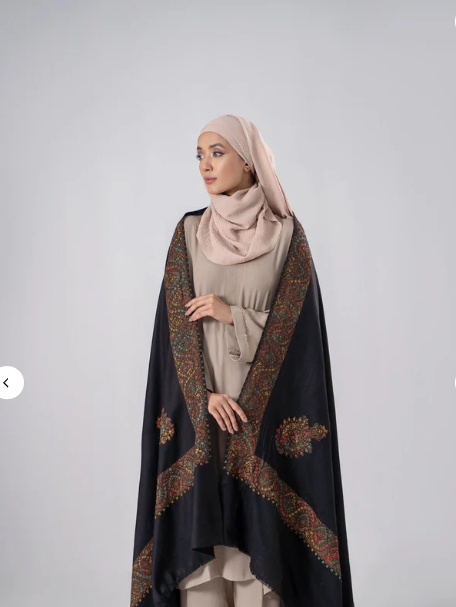
In South Asia, velvet became closely tied to luxury through Zardozi embroidery, a gold and silver thread technique that reached its peak under Mughal patronage. Zardozi comes from the Persian words zar, meaning gold, and dozi, meaning embroidery. After Partition, the craft saw a strong revival in Pakistan, and today it remains one of the most recognisable styles on velvet shawls made for weddings and formal winter events.
This mix of heavy fabric and rich embroidery is exactly why velvet shawls feel different to wear. They are not meant for a regular Tuesday. They are meant for the one event where you want the shawl itself to be part of the outfit’s statement.
Wool vs Pashmina vs Velvet: A Side by Side Look
|
Feature
|
Wool Shawl
|
Pashmina Shawl
|
Velvet Shawl
|
|
Fiber width
|
25 to 40 microns
|
12 to 16 microns
|
Pile woven, not fiber based
|
|
Warmth
|
Good, needs more weight for same warmth
|
Excellent for its light weight
|
Good, depends on fabric weight
|
|
Feel
|
Slightly coarse, sturdy
|
Extremely soft, delicate
|
Plush, smooth, rich texture
|
|
Best for
|
Daily wear, office, travel
|
Special outings, gifting, layering
|
Weddings, evening events, festive wear
|
|
Price range
|
Most affordable
|
Premium to luxury
|
Mid to high, depends on embroidery
|
|
Care
|
Dry clean or gentle hand wash
|
Dry clean only, store with care
|
Dry clean recommended
|
|
Durability
|
Very high
|
Moderate, needs gentle handling
|
High with good quality fabric
|
How to Decide Which One Is Right for You
Think about how often you will actually wear a shawl before you think about how it looks on the hanger. If you need something for daily office wear, school runs, or general winter use, wool gives you the best value and the longest life. If you want one special piece that feels luxurious every time you wrap it around your shoulders, pashmina is worth the investment, especially in a neutral shade you can wear for years. If you are dressing for a wedding, a dinner, or any event where the outfit needs to make an impression, a velvet shawl with embroidery work does that job better than either wool or pashmina.
Many Pakistani women end up owning all three, simply because each one solves a different problem on a different day. You can browse a wide range of winter shawls online to compare textures, weights, and price points before deciding what fits your wardrobe and your budget.
How to Spot a Real Pashmina From a Fake One
The shawl market has its share of imitation pashmina, usually blended with silk or synthetic fiber and sold at a steep markup. A few simple checks help. Genuine pashmina feels soft without feeling slippery, and it should not carry a shiny synthetic sheen under light. It is also noticeably light for its size. If a shawl labeled as pure pashmina feels heavy or coarse, it likely contains wool or synthetic blends. Price is also a clue. Hand spinning and weaving genuine pashmina takes weeks of skilled labor, so an unusually low price on a shawl marketed as one hundred percent pashmina is rarely a good sign.
Keeping Your Shawl Looking New Year After Year
A good shawl is an investment, so it deserves a bit of care. Always dry clean embroidered, velvet, or pashmina pieces rather than washing them at home. Store shawls folded inside a breathable cotton bag instead of plastic, since trapped moisture damages natural fibers over time. Let your shawl air out after wearing it before folding it away, and keep it out of direct sunlight for long periods, since this fades natural dyes faster than most people expect.
Choosing With Confidence, Not Confusion
Once you understand what wool, pashmina, and velvet actually offer, the choice stops feeling overwhelming. Wool gives you durability for daily life. Pashmina gives you light, luxurious warmth for the moments that matter. Velvet gives you presence for the events where you want to be remembered.
The next time you stand in front of a shelf full of shawls, you will not just be picking a colour or a price tag. You will know exactly what you are paying for, and why it matters, all the way back to the hands that made it.


 Search in Classifieds
 Search in Groups
 Search in Polls
 Search in Members
 Search in Members
 Search in News
 Search in Businesses
 Search in Contests
 Search in Events
 Search in Music Albums
 Search in Music Songs
 Search in Quotes
 Search in Site Team



Share this page with your family and friends.